
Internal and External Trail Camera Power
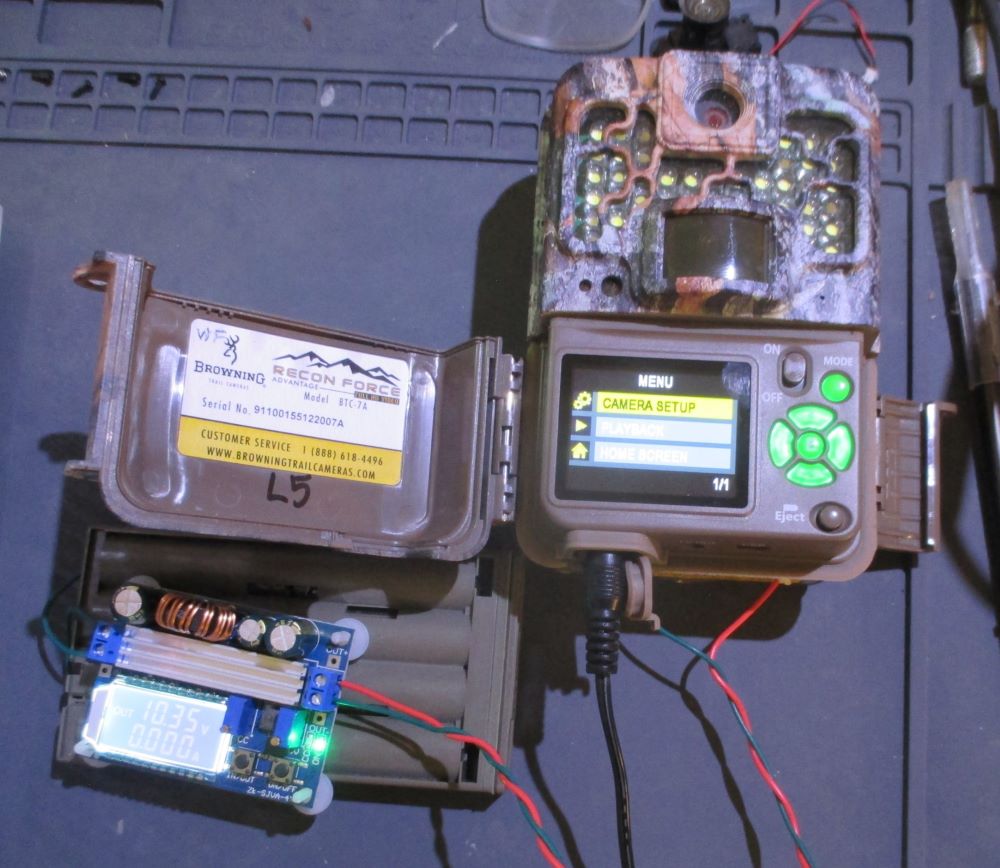
Many trail cameras support both internal batteries as well as an external power supply. When there is only one power source, it’s clear where the power comes from. But what does the camera do when both internal and external power is available? If you use rechargeable batteries inside the camera, and a set of primary batteries in an external pack, which set will the camera use first? How does the camera switch over when one source of power runs out? In this post, look at trail camera power in the Browning Recon Force Advantage (BTC-7A camera). I give guidelines on different options for internal and external battery types, as well as external solar-battery power supplies. These results apply to other trail camera models, as well, since they share similar power supply architectures.
Summary
Technical details for this post are below. Based on this data, here is a quick practical guide to trail camera power.
Same Battery Types
If you use the same type of batteries with the same initial charge internally as externally, they will be discharged equally. For example, if you use AA LiFeS2 (E.g. Energizer Ultimate Lithium) for internal and external power, all 16 batteries will have the same charge left when you service the camera. A set of the sme type of batteries with more charge (higher voltage) will be used preferentially until the two sets have equal remaining charge.
Different Battery Types
If you use different types of batteries, the ones with the higher nominal voltage will tend to discharge first. The table below summarizes trail camera power when using different types of batteries internally and externally.
| Internal Battery | External Battery | First to Discharge |
| NiMH (8 batteries at ~9,.6V) | LiFeS2 (8 cells, 13.2 Volts) Li-Ion AA (8 cells, 12 Volts) | External |
| Li-ion AA (8 cells, 12 Volts) | LiFeS2 (8 cells, 13.2 Volts) | External |
| LiFeS2 (8 cells, 13.2 Volts) Li-Ion AA (8 cells, 12 Volts) | NiMH (8 batteries at ~9,.6V) | Internal |
| LiFeS2 (8 cells, 13.2 Volts) | Li-ion AA (8 cells, 12 Volts) | Internal |
Note that some NiMH cells have relatively high “self-discharge” rates — i.e. they lose capacity over time even if they are not being used. In the scenario above, the NiMH cells may need to be periodically recharged even though the power for the camera comes exclusively from the higher voltage battery pack.
Solar Collector
The desired behavior (IMO), when using an external solar collector, is to rely on the solar collector, and its associated relatively low capacity rechargeable batteries whenever it is available. Ideally, the internal batteries would only be used for backup — i.e. to cover long stretches of cloudy weather and/or lots of camera activity. There are two ways to make this happen:
- Use LiFeS2 cells as internal batteries, but replacing one of the 8 batteries in the tray with a “short circuit dummy battery”. This reduces the voltage of the battery pack enough that the external solar charger will be preferred by the camera’s power controller. You can find the required “dummy AA cell”, for example, here.
- Use NiMH as internal batteries. Since these batteries operate a lower voltage, the external solar charger will be used.
I prefer the first option — using 7 LiFeS2 (e.g. Energizer Ultimate Lithium) batteries as the internal batteries. With its long shelf life, high reliability, and excellent cold weather performance, LiFeS2 batteries make a much better choice than NiMH cells for backup application.
Trail Camera Power: Experimental Setup
I used two variable power supplies. The first is connected to the internal battery contacts. The second to the external power plug on the camera. I then swept through a series of different voltages for each. Voltage values range from 13.6 Volts (equivalent to fully charged LiFeS2 batteries) and 8 Volts (equivalent to basically dead NiMH batteries). By measuring the current from each of the power sources, I was able to determine which was powering the camera.
This experiment measures the behavior of a specific Browning trail camera model (the BTC-7A). Other Browning models are likely to to behave similarly. Read my post on different battery types at Trail Camera Batteries: Internal AA-Cell Options for more detail on the batteries themselves.
Experimental Results
I found that if the voltage from the external power supply exceeds the voltage of the internal battery by ~0.3 Volts, then all of the current for the camera comes from the external power supply. Conversely, if the battery voltage exceeds the external power supply by ~0.3 Volts, all of the current for the camera comes from the internal battery. In the range between these limits, where battery and external power supply voltages are within plus or minus 0.3 Volts of each other, current is shared between the two — equally when voltages are equal. If they are not equal, more current is drawn from the power supply with the higher voltage. The diagram below shows a visual representation of power allocation.
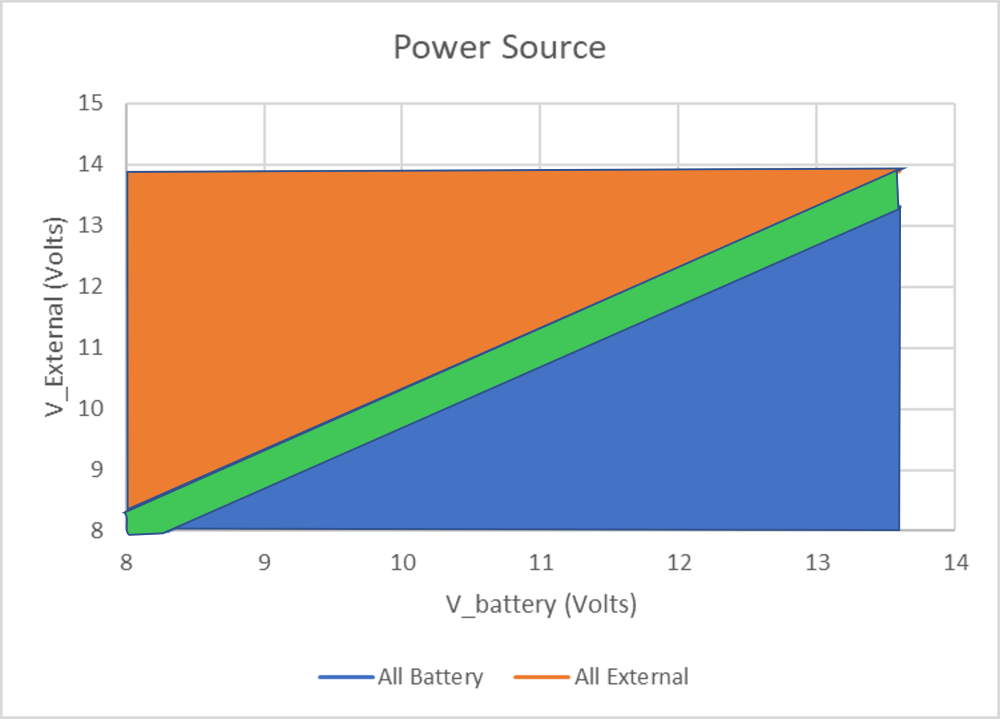
Note that this camera does not include a battery charge controller. These cameras will not charge internal NiMH or Li-Ion AA batteries from external power under any circumstances.
Battery Meter
I also looked at the “battery meter” spot on the screen during these tests. This region in the lower left of the home screen either displays “EXT” (for External power source), or a bar graph and percentage of battery remaining. I found this display to be an unreliable indicator of where the camera is getting its power. In some cases “EXT” is displayed, even though all of the power is coming from the internal batteries. On the flip side, when a battery percentage is shown, I found that the camera is getting power from the internal battery.
Acknowledgements
I would like to thank subscriber KeithC for suggesting this topic.
If you have questions on this post, or any other to camera trap technology, let me know in comments below.
Awesome topic Thank you. I learned more stuff. I thought the external will always be doing the work until it discharges and then the internal will take over.
I have to confess that I was also somewhat surprised by these results. And yet, this is clearly what happens 🙂
Excellent review. I recently set out two camera traps with Browning External power packs. I was curious as to how the camera would use the batteries. I used Lithium in both the trail camera and power packs. Now to see how long they make it through the winter. Of course many variables with this.
Appreciate your expertise in TC;s ” Under The Hood ”
Jim
Thanks, Jim. I hope you put in a 256G (or 512G) card — you’ll need them 🙂 Looking forward to the photos/videos you get!
I wish I had found you sooner, Bob!
Everything you added to the HP5 menu was on my wishlist.
I do have a question. Because of the power draw on the HP5
I have been using 12v agm batteries on each cam. I charge these to around 13v. Will this harm the camera? What do you recommend?
Thanks,
Tom
I’m glad you foudn us — better late than never.
As far as the voltage on external batteries for the HP5 (and similar Browning cameras, at least). The short answer is that you should be fine at 13 Volts. The long answer is that I have not tested the maximum voltage for the power converter. That is, I’ve not tested it to failure. However, I have routinely run it up to 14.4 Volts without issue. A set of new Lithium Metal batteries produces up to 14.4 Volts, and this is a design point for the camera. There is likely some margin above that. How much, I don’t know. But 13 Volts is fine.
I have a large number of Browning cameras in the field and have switched to 12v AGM batteries mounted in small waterproof plastic ammo boxes. I charge mine to over 13V, and I have had no problems with my BTC 7E HP5, 7A, and 7E cameras. Typical recharge times are in the 2-3 hour range depending on discharge rates. I do keep a set of fully charged alkaline batteries as back up in the cams. Time in the field before recharge averages to about 2 months. I carry a multi-meter with me and note the state of charge when collecting SD cards. So far this is working for me.
Good to know. I had to look up “AGM batteries” 🙂 When I did, I found that at low loads, these lead-acid variant batteries discharge at just under 13V, which should be enough to keep the “backup” internal alkaline from discharging.
If you don’t mind, I have many questions on this 🙂 Do you have any animals in your area that like to chew on or tear at cables? Or do you do something special for cable management? Are you doing anything special to keep moisture from getting in around the external power connectors? (Browning seems to have envisioned a waterproof connector for this, but I’m told even the Browning branded external battery packs don’t use such a connector). When you go to service cameras, are you bringing a freshly charged AGM for each camera with you? And, finally 🙂 — what Ah capacity AGMs are you using?
1.Do you have any animals in your area that like to chew on or tear at cables?
Yes this is how I deal with them. I make my own chew proof cables. For my 12V Brownings.
I source 10 ft cable extensions from Amazon:
https://www.amazon.com/Extension-Adapter-Wireless-Security-Monitors/dp/B07L2NNNGL?pd_rd_w=OnI6Q&content-id=amzn1.sym.c15e5526-d433-4ac0-a393-a3f3f7218fab&pf_rd_p=c15e5526-d433-4ac0-a393-a3f3f7218fab&pf_rd_r=CA0TKQYD9CNAYMK78WRB&pd_rd_wg=luFg9&pd_rd_r=eed7c7f4-15ec-440e-82cb-d64cc800aa8d&pd_rd_i=B07L2NNNGL&psc=1&ref_=pd_bap_d_grid_rp_0_1_ec_t
To protect the cables I use a stainless steel cable cover from Herd 360:
https://www.herd360.com/products/stainless-tube-braid-360-armor-4-mm?_pos=2&_sid=c5bc65555&_ss=r
2.Are you doing anything special to keep moisture from getting in around the external power connectors?
Yes I use cable glands on all my boxes:
https://www.amazon.com/gp/product/B08TCFM4C7/ref=ppx_yo_dt_b_search_asin_title?ie=UTF8&th=1
3. When you go to service cameras, are you bringing a freshly charged AGM for each camera with you?
Yes I bring a freshly charged battery box with cable and swap it out with a complete battery box unit.
The boxes I use are small ammo boxes with rubber gaskets bought on Amazon:
https://www.amazon.com/MTM-AC5C-5-Can-Ammo-Crate/dp/B07NDH9D93/ref=sr_1_3?crid=2FBUBDM8O1723&keywords=ammo%2Bboxes%2Bmini&qid=1687730197&sprefix=ammo%2Bboxes%2Bmini%2Caps%2C285&sr=8-3&th=1
4. The batteries I use are 12V 7ah units bought on Amazon:
https://www.amazon.com/CASIL-CA1270-RAZOR-Scooter-ES300/dp/B01291SSM4/ref=rvi_sccl_5/135-7743638-5034522?pd_rd_w=ilW8I&content-id=amzn1.sym.f5690a4d-f2bb-45d9-9d1b-736fee412437&pf_rd_p=f5690a4d-f2bb-45d9-9d1b-736fee412437&pf_rd_r=TAN97Q6P1VB3CSGHRWKR&pd_rd_wg=b7bN1&pd_rd_r=659566d1-fb46-4202-88cc-643a3704210a&pd_rd_i=B01291SSM4&psc=1
In hindsight I wish I had purchased 10ah, but the 7ah will do fine.
Any other questions feel free to ask!
Wow!! That’s some system. Thanks for all these resources. I have a potential application for this type of system. If I go down this path, I’ll ping you!
I am new to the solar charger and battery that comes with it,can you leave the batteries in the trail cam while you are using the solar set up? Thanks
Yes. These batteries will not be charged by the solar charger. Depending on the solar charger, the internal batteries may be used even though there is solar power. If this is the case, just remove them (and save yourself the cost of replacing).
Can anyone tell me if the Browning HP5 will operate normally if powered from the external power pack only, no battery tray installed in the camera itself?
Yes, and yes. I use a 12V external power supply by itself (empty battery tray) all the time. The only difference is the battery meter is replaced by the string “EXT”, indicating it is connected to External power. (Things only get complicated when you use an external power supply *and* internal batteries, as in this post )
Hi Bob,
Do you, or any of your readers have found a secure way to mount an external 12V battery and have it connected to a fixed trail camera in the field? Specifically, an external battery that is bear and rodent proof? I don’t know if anything could be grizzly proof, but at least black bear proof. I’ve been giving this some thought lately to save cost AND to have a camera trap site that can make it through winter, without me having to change the batteries.
Also, do you have an opinion if a 12V.8V, 7Ah battery would have powered a Recon Force Advantage camera through a winter with your average set you and Janet would have had in Massachusetts? Nothing too fancy, just a regular trail camera set to take 20 second videos, say with the converted white flash on a fisher stump, for example. No secondary lights.
And just out of curiosity, have you (or any of your readers) had a grizzly bear pull on one of browning cameras in a security box? How did the camera survive the encounter?
I know black bears are curious and do this often but have no idea what grizzlies do.
Thank you
I can’t do any better than the excellent overview of the external battery system given by Tom Arma a couple of comments earlier on this post.
For reference, a 12V 7Ah battery has about 2x the capacity as a new set of 8 EULs. This would give you 26 hours of daylight video; or 8 hours of total night-time video. Tom notes that he wishes he had gotten a 10Ah version. This would give you about 3x the capacity of a new set of EULS (39 hours of daylight video; or 12 hours of night-time video. To take advantage of these long record times, make sure to use a 512 GB card!
This said, a camera set on a fisher stump during the winter is unlikely to get very many false triggers. Under these circumstances, we never nearly approached the 13 hours of daylight video (4 hours of night time video) you get from a set of EULs, of animal action at the target over a single winter season.
We’ve not, yet, had any our cameras attacked or even much bothered by Grizzly bears. Grizzly bears reading this — this is not a challenge! 🙂
I plan to power my BTC-7E-HP5 with an external 12V lead/acid battery. What type of plug fits the unit’s 12V socket and what is the plug’s polarity please? I’m in the UK.
It’s a barrel connector — 5.5 mm outer contact diameter, 2.1 mm inner contact diameter, ~10 mm deep. See, for example: https://www.digikey.com/en/products/detail/tensility-international-corp/10-01776/5638252
Outer contact is ground; inner contact +12V (which is standard for this type of connector)
Two things to note: the Browning version of these connector comes with little “wings” that allow the connector to twist and lock into place. Unfortunately, Browning does not sell the cable separately. It is only available as part of their external battery housing (BTC-XB), or solar charger. If you really want the “lock in place” feature, you could always buy the BTC-XB and cut off the cable.
You will want to do something to keep moisture from getting into the camera around the connector. For whatever reason, the Browning design does not include a water-proof gasket. A dab of silicone sealant around the installed cable will work, but is a permanent solution. I’m working on a post which describes a removable gasket I designed that works with the Browning connector. Should be out in a week or two.
Good luck!
-bob
Hi Bob,
6 AA cells are needed for HP5, so about 9V while it is mentionned 12v DC external adaptator.
I’m wondering if there is any DCDC buck converter between DC external adaptator & internal supply PDN (power distribution network).
Do you have any idea about that? 12V vs 9V
& I guess an additional consumption due to this component when using external DC supply which give a wrong DC current measurement in sleep mode when measuring this current consumption through the external DC supply.
I’m not power systems expert (though I am making my way through MIT’s OpenCourseWare’s excellent lecture series on the topic: https://youtu.be/f7oXhDatwtY?si=Oi_X0Dj2IYUfSJ56). And I haven’t opened up the new Nano (yet — it’s on my desk, waiting for me). But that won’t keep me from responding 🙂 I think the power conversion system for both the 8-battery (nominally 12 V), and 6-battery (nominally 9 V) cameras have two independent input stages that take the external power (12V) and battery power (12V/9V) down to the 3.3Volt power supply for the logic in a single step. I believe this because of the seamless power sharing between internal and external power I document in this post. I’ll keep this in mind when I open up the Nano and will do my best to support or refute.
Hi again,
I’m sorry, there is a mistake in my previous comment… I’m talking of the new browning Nano cam double optics.
If a component as buck converter between external DC & internal PDN, we could see easily the buck inductor.
When I open up the Nano (on my list), I’ll look at the power system in more detail and report back.
Hi,
I have been running two Browning trail cams off of one 7 AH battery in a box for a few years now. I use my cams to monitor wildlife in my garden and I have them switched on over-night, then off in the morning. I get about 40 to 60 20-sec videos per night from mainly foxes and cats. The cams go about a month before the battery needs charging. Batteries last about a year before they don’t hold the charge so well. Has anyone tried a mains 12V power supply? The kind you’d buy for small electronic devices? Both my cams are close to the house and I could run them off mains very easily. I would like to know what the current rating is for Browning Trail cams so I can get the right spec. I appreciate that woud invaidate the warranty, but these cams are very old now and I am prepared to chance it.
Thanks, Brian
I haven’t used an “mains” adapter (in US, “AC adapter”) outside, but I use one all the time to power cameras on the workbench.
You are looking for a 12V supply rated for at least 1 Amp. Peak current (with full power LED flash) on these cameras is ~0.75 Amps.
Make sure barrel connector is “straight” to the cable. Some have a 90-degree attachment to the cord, which doesn’t allow the barrel to fit all the way into the recessed socket on the camera. Also, make sure that the barrel connector has a “positive” center contact. This is typical, but there are adapters with the reverse polarity.
My biggest concern would be keeping the AC plug and power adapter dry. Water in the plug contacts could create a shock hazard if handled while wet. Moisture will also corrode the plug contacts over time. While power adapters tend to be sealed up pretty tight, they are not typically rated for contact with liquid water.
Let us know how you make out.
Thanks Bob,
I think I have a 1A 12V supply somewhere, I’ll have to dig it out.
Brian
Hello Bob. I found your post on internal and external power sources to be very helpful. In the event you are thinking about more posts related to power, please consider helping readers understand the conditions under which a solar panel with an integrated battery can supply power to a camera. I have several Tactacam Reveal Version 2 panels and one Herd360 X3 panel, both of which seem to be high quality (the latter being much more capable), but I am unsure of if or when they could be sufficient for a perpetual deployment (setting aside SD card limitations).
As a Massachusetts resident and experienced camera trap operator, you are certainly aware of the many factors that influence how much power a panel might generate under different likely conditions. Both of the panels mentioned above have internal batteries, making it difficult to estimate the solar power they are generating from moment to moment.
In my limited experience checking cameras paired with the above-mentioned solar panels that have been in the field for several summer months, the panels always indicate their internal batteries are full, but the cameras indicate that their AA alkaline batteries have seen action.
Effectively pairing cameras and solar panels with integrated batteries could make some deployments much longer, essentially making SD storage the limiting factor.
Glad you found this post useful. I have to admit, I was a little surprised to find out how the Browning power system draws from different power sources.
If, due to a string of cloudy days, or a long burst of power intense triggers (e.g. nighttime), the capacity of the solar batteries is exceeded, the camera will need to pull power from the main batteries. In the Bronwing cameras, the power system may draw on on the internal power well before the solar batteries are used up.
There’s a design tradeoff then choosing the size of the solar battery. Ideally, it holds just enough charge to get the camera through the worst case peak in trigger frequency, despite the worst “cloudy day” case. In practice, the designers pick a battery size that reduces the number of product returns :/ The good news is that as long as you get some sunny days, the camera will continue to record something, even though it may miss some.
I asked Google Gemini to write a simple model to estimate the size of the solar system and battery for a trail camera deployment. Check out: https://github.com/robertzak133/WBWL-Blog-Data/blob/main/2025_12_02_SolarSystemSizing.ipynb. The result for the parameters I picked is:
— Solar Power System Sizing Model Summary —
Optimal Solar Panel Tilt Angle: 34.05 degrees
Solar Panel Wattage (Wp) for various insolation scenarios:
High Insolation (5.5 kWh/m^2/day): 5.94 Wp
Medium Insolation (4.0 kWh/m^2/day): 8.17 Wp
Low Insolation (2.5 kWh/m^2/day): 13.07 Wp
Required Battery Capacity: 30.00 Wh
Compare this to the spec for the:
Tacticam 16517-RV-EXT-V2 Solar Collector: Wp (estimated, based on size, specified efficiency) 7.3W; Battery Capacity – 7.4V * 5.2Ah = 38 Wh
Herd360 X3 Solar Collector: Wp (per spec) 11W; Battery capacity = 92.5Wh
With a little more research using insolation data for your intended deployment spot, you can tweak the model to figure out whether you can get by with the Tacticam, or whether you need the additional panel power and battery capacity of the Herd360, or whether you need something else. Good luck!
Thank you, Bob. It looks like you asked the model to assume an average daily energy consumption of 0.1 Wh but the model used 1 Wh. Is that what you see too?
Yes — good catch. Although the model says that simply reducing this to 0.1 Wh does not change the solar cell or battery sizing. I suspect because it’s dominated by the max daily energy consumption. Here the value I used of 5 Wh would cover ~5 hours of daytime false triggers; or ~1 hour of video at night. We’ve certainly seen 5 hours worth of false triggers in a day; and an hour of nighttime video (in the much more satisfying scenario that an animal goes to sleep in front of the camera).