
Nikon SB28 Flash Failure: Blinking LCD
Nikon’s Speedlight SB28 flash is a favorite with camera trappers. It’s surprisingly rugged, operates well hot or cold, and will fire in quick succession at medium intensity for a series of photos. Coupled with a wireless “hot shoe”, it makes a great remote flash for a custom camera trap.

Unfortunately, the SB28 is also long out of production. Although it is rugged, these units don’t last forever. A typical failure mode has the entire LCD panel blinking with the unit unable to take any further commands.
In this post, I’ll give my best advice on the symptoms and repair of these units. With a caveat, which is I have not yet personally made the repair I describe. I’m pretty sure it will work, but what do you expect from free advice from the internet?
References
There are several sources online for repair manuals for the SB28 behind nominal paywalls. Having purchased one of these, I quickly found out that it it refers repeatedly to the SB25 (a very similar model) for disassembly instructions, etc. Importantly, the SB25 manual includes a troubleshooting guide which is oh-so-close to being useful for this case.
I don’t remember what license agreement I agreed to when I purchased them, but I will not be reposting these documents in their entirety for this post. I will be posting a few screen clippings with the “best parts.”
Symptoms
As mentioned before, the symptoms for this failure are quite simple. With new batteries installed, the unit will not do anything but flash all of the elements on the LCD display. No amount of button pushing or verbal persuasion helps.
Debug
The SB25 repair manual has a section on troubleshooting, which I excerpt below. The general form is a list of symptoms which map to a list of possible failures.

Note the good news and bad news, here. The good news is that the list of symptoms includes just what we’re looking for:
LCD indications blink with power switch set at “ON”
The bad news is that this is the only symptom in the list which does not point to an entry in the “Specific Failures” section, below.

We’re on our own.
Failed Discharge Capacitor
I suspect that the failure in these cameras is of the main 1400uF, 370 Volt capacitor which stores charge at high potential to discharge the Xenon flash tubes. This is an electrolytic capacitor, which have well-documented failure-in-time wearout mechanisms. Especially in high usage scenarios (like automated triggering storms).

The SB28 block diagram references three separate monitoring circuits for this critical component:
- Circuit for Safety: which probably limits the maximum voltage on the capacitor to prevent a fault in the charging circuit from blowing up the capacitor
- Sensor Circuit for Voltage: which determines when the capactor has been charged so that it can disable to charging circuit
- Circuit for Pressure Rise: I think this is a poor translation of “circuit for voltage (potential) rise”. It probably detects the the voltage on the capacitor is actually rising rising as the capacitor is charged.
My bet is that the main capacitor in these cameras has failed – either shorted or open. This condition is detected by one or more of the sensors above. Since the flash will not work without the capacitor, and since trying to charge a dead capacitor could cause further damage, the internal microcontroller aborts the primary firmware and just flashes the LCD in a signal that things are fatally wrong.
Unfortunately, my broken SB28 did not survive our move to Montana (or if it did, I have no idea where it is), so I can’t test this idea directly.
But somebody could. By removing the right rubber cover, to access the two pins of this capacitor. After first discharging the capacitor (safety first), then using a multimeter to see if it’s still a 1400 uF capacitor, or whether it’s open or shorted.

Repair
Let’s assume that this is the problem. All you’d need to do is replace the capacitor.
Removal
The SB25 manual contains disassembly instructions (the SB28 repair manual merely refers to the SB25 manual). The process to disassemble the whole unit is involved, but simply getting at the Flash Head is not too bad.


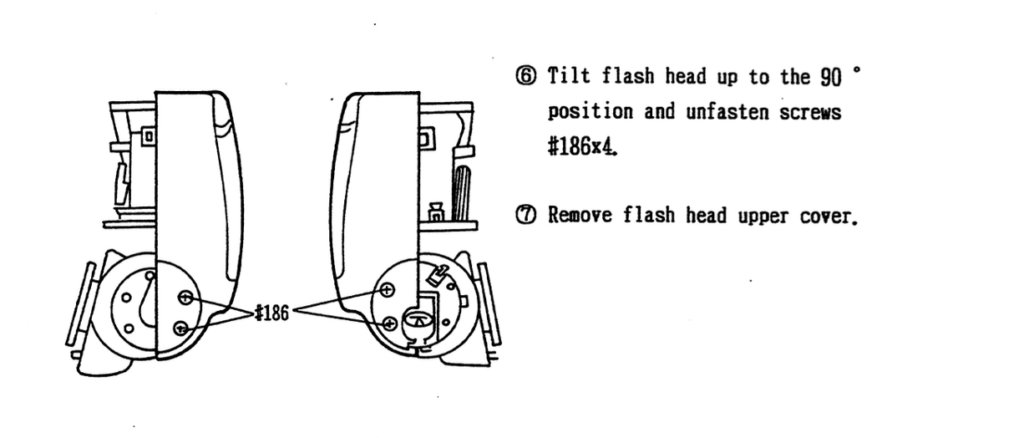
I took some photos when I took my SB28 apart a few years ago which I’ve made into the (sketchy) video below.
The first thing to do once you have one of these capacitors in your hand is to measure its length and diameter. Whatever replacement you find online will need to meet the electrical charactertistics (i.e. 1400 uF and 370 Volts), as well as fit within the highly integrated mechanical design of the SB28. Based on measurements of the outside plastic cover, I estimate that the enclosed capacitor is ~30 mm in diameter, and ~50 mm long.
Parts
Searching for “1400 uF / 370V capacitor for Nikon SB-28 Flash” yields some promising results, but no direct matches, and nothing that says, “will work in a Nikon SB-28.
The “Photo Flash” capacitors I found were rated at a lower voltage (e.g. 330 Volts), and/or did not match the required mechanical dimensions of the Nikon part (e.g. 35 mm Diameter and 45 mm long). I found a couple of factory replacements for other Nikon flash types on eBay, but nothing for the SB28.
It may be unobtanium.
Of course, if you have an SB28 which is fatally dead due to some failure other than the main capacitor, you could try a transplant.
Summary
Due to the difficulty in finding an exact form fit replacement, as well as cost and labor of replacing the main capacitor in the SB28, it’s probably still cheaper to buy a (working) used SB28 online. But if you are inclined to try to fix yours, this post gives a plan on how to do it.
If you find this post, and use it to try to repair your SB28, please let us know. I’d like to update this post with some solid information on capacitor specs (especially size) and final outcome.
Comments
Nikon SB28 Flash Failure: Blinking LCD — No Comments
HTML tags allowed in your comment: <a href="" title=""> <abbr title=""> <acronym title=""> <b> <blockquote cite=""> <cite> <code> <del datetime=""> <em> <i> <q cite=""> <s> <strike> <strong>